
Post
Omega Speedmaster: The Watch That Went to the Moon
Th5
Omega Speedmaster: The Watch That Went to the Moon
Introduction: A Timepiece Beyond Earth
Few watches in history possess a story as legendary as the Omega Speedmaster. More than just a chronograph, the Omega Speedmaster represents one of humanity’s greatest achievements — the exploration of space and the first steps on the moon. Its connection to NASA and the Apollo missions transformed the watch into a global icon recognized far beyond the world of horology.
Created by Omega, the Omega Speedmaster began life as a professional racing chronograph in 1957. Yet through extraordinary durability, precision, and reliability, it evolved into the only watch officially qualified by NASA for extravehicular activity.
When astronaut Buzz Aldrin walked on the lunar surface in 1969 wearing an Omega Speedmaster, the watch secured its place forever in human history. From that moment forward, it became known simply as “The Moonwatch.”
Today, the Omega Speedmaster remains one of the most respected and collectible chronographs ever produced. Its combination of space heritage, timeless design, and mechanical excellence continues to inspire collectors, astronauts, and enthusiasts around the world.
For many watch lovers, owning an Omega Speedmaster means owning a genuine piece of human exploration history.
The Origins of the Omega Speedmaster
The story of the Omega Speedmaster began in 1957 during an era when motorsports were growing rapidly in popularity.
Originally designed for professional racing drivers, the watch focused on precision timing, durability, and readability under demanding conditions. The early Omega Speedmaster featured a stainless steel case, black dial, and external tachymeter bezel that allowed drivers to calculate average speeds easily.
Unlike many chronographs of the period, the tachymeter scale was placed on the bezel rather than the dial, significantly improving legibility and functionality.
The clean layout of the Omega Speedmaster made it exceptionally easy to read during high-speed racing events. Large luminous hands, contrasting subdials, and practical proportions contributed to its professional character.
Powered by robust manual-wind chronograph movements, the Omega Speedmaster quickly gained a reputation for reliability and precision among racing enthusiasts and professionals.
At the time, nobody could have imagined that this racing chronograph would eventually travel beyond Earth itself.
NASA and the Space Race
During the early 1960s, the United States and the Soviet Union were locked in the intense competition of the Space Race.
NASA required equipment capable of surviving some of the harshest environments ever encountered by humans. Watches needed to function under extreme temperatures, intense vibration, vacuum conditions, acceleration forces, and radiation exposure.
Several watch brands submitted timepieces for NASA testing, but the Omega Speedmaster proved uniquely capable of surviving the brutal evaluation process.
The tests included exposure to temperatures ranging from extreme heat to freezing cold, violent shocks, decompression, humidity, and prolonged acceleration.
Remarkably, the Omega Speedmaster continued functioning reliably while many competing watches failed.
In 1965, NASA officially qualified the Omega Speedmaster for all manned space missions and extravehicular activities.
This achievement fundamentally transformed the identity of the watch. No longer simply a racing chronograph, the Omega Speedmaster became an essential tool for space exploration.
The Moon Landing and Historic Legacy
The defining moment in the history of the Omega Speedmaster occurred on July 20, 1969.
During the Apollo 11 mission, astronaut Buzz Aldrin stepped onto the lunar surface while wearing his Omega Speedmaster Professional. This made the Speedmaster the first watch worn on another celestial body.
That historic event forever linked the Omega Speedmaster to one of humanity’s greatest accomplishments.
The moon landing elevated the watch beyond the world of luxury goods or professional instruments. It became a symbol of courage, scientific ambition, and human progress.
Collectors often refer to the Omega Speedmaster as “The Moonwatch” because of this unparalleled historical connection.
Few products in any industry can claim such direct involvement in a moment of global historical significance.
The fact that astronauts relied on the Omega Speedmaster during life-critical missions further reinforced its reputation for reliability and engineering excellence.
The Design of the Omega Speedmaster
One reason the Omega Speedmaster remains so beloved is its timeless and highly functional design.
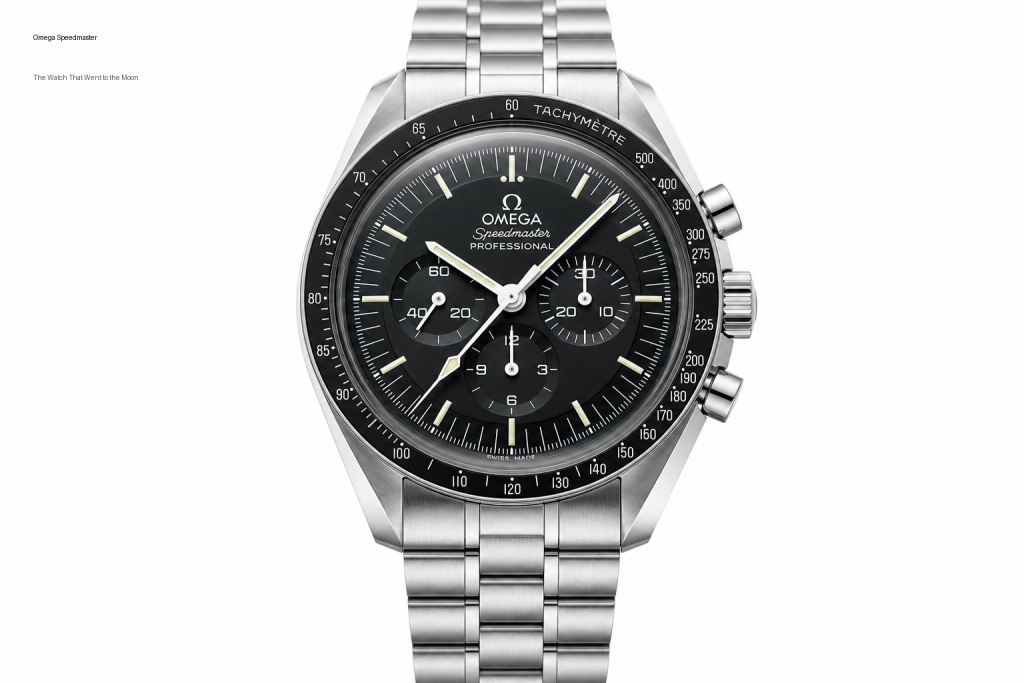
The classic 42mm stainless steel case strikes an ideal balance between robustness and wearability. The asymmetrical case shape, introduced to protect the chronograph pushers and crown, has become a defining characteristic of the watch.
The black dial of the Omega Speedmaster prioritizes maximum readability. White hands and subdial markings create strong contrast, ensuring excellent visibility under all conditions.
The tri-compax chronograph layout includes counters for running seconds, 30-minute timing, and 12-hour timing functions.
The tachymeter bezel remains another iconic feature of the Omega Speedmaster, reflecting the watch’s original motorsport heritage.
Despite decades of technological evolution, the essential appearance of the Omega Speedmaster has remained remarkably consistent. This continuity demonstrates the strength of the original design.
The watch feels equally relevant today because it was engineered with pure functionality and timeless proportions in mind.
Mechanical Excellence and Reliability
At the heart of the Omega Speedmaster lies a highly respected chronograph movement renowned for durability and precision.
Historically, the watch utilized the legendary Calibre 861 and later evolutions of the movement that maintained the robust manual-wind architecture beloved by collectors.
Modern Omega Speedmaster models continue to emphasize mechanical integrity and historical continuity while incorporating contemporary improvements in accuracy and reliability.
The manual-wind nature of the watch creates a strong emotional connection between wearer and movement. Many enthusiasts appreciate the daily ritual of winding their Omega Speedmaster, seeing it as part of the ownership experience.
The chronograph mechanism itself is celebrated for its smooth operation and dependable performance.
Collectors admire the Omega Speedmaster because it combines genuine tool-watch durability with the beauty and craftsmanship of traditional Swiss horology.
NASA Partnership and Continued Space Use
One of the most extraordinary aspects of the Omega is that its relationship with NASA continues to this day.
Modern Speedmaster models remain part of space missions and astronaut equipment, continuing the legacy established during the Apollo era.
The fact that the Omega is still trusted in space more than half a century after the moon landing speaks volumes about the original engineering excellence of the watch.
Very few products in history remain operationally relevant for such an extended period without losing their essential identity.
This ongoing connection to space exploration gives the Omega unmatched authenticity within the world of luxury sports watches.
For many collectors, the watch represents far more than aesthetics or mechanical craftsmanship — it symbolizes human exploration itself.
Popularity Among Collectors
The Omega enjoys one of the strongest collector communities in modern horology.
Enthusiasts appreciate the watch for numerous reasons: its historical significance, mechanical reliability, timeless design, and emotional connection to the Apollo missions.
Vintage references of the Omega are especially sought after, with certain rare models commanding extraordinary values at auctions.
At the same time, modern Speedmaster models remain highly popular because they preserve the spirit of the original Moonwatch while offering contemporary manufacturing quality.
The versatility of the Omega also contributes to its appeal. It works equally well as a professional tool watch, a historical collectible, and an everyday luxury timepiece.
Very few watches manage to balance so many identities successfully.
Why Omega Speedmaster Remains Iconic
The enduring power of the Omega comes from the authenticity of its story.
Unlike watches that rely heavily on marketing mythology, the Speedmaster genuinely participated in one of humanity’s greatest historical achievements.
Its design was not created for fashion but for performance. Its reputation was earned through real-world testing under the most extreme conditions imaginable.
The Omega also represents a perfect balance between functionality and elegance. It feels purposeful, durable, and sophisticated without becoming overly complicated or excessively luxurious.
This authenticity explains why the watch continues to resonate so deeply with collectors across generations.
Conclusion: The Chronograph That Made History
The Omega stands as one of the greatest achievements in the history of watchmaking.
From its origins as a racing chronograph to its role in NASA’s lunar missions, the watch has transcended traditional horology to become a symbol of exploration, courage, and human achievement.
Its timeless design, robust construction, and extraordinary historical significance ensure that the Omega remains one of the most respected and collectible watches ever created.
For collectors and enthusiasts alike, owning an Omega is about more than telling time. It is about carrying a piece of history on the wrist — a reminder of the moment humanity first stepped onto another world.
In every sense, the Omega truly is the watch that went to the moon.
