
Post
Audemars Piguet Royal Oak: Luxury in Steel
Th5
Audemars Piguet Royal Oak: Luxury in Steel
Introduction: The Watch That Changed Luxury Forever
Few watches in the history of horology have transformed the industry as dramatically as the Audemars Piguet Royal Oak. Introduced in 1972, the Royal Oak did far more than launch a successful new model — it created an entirely new category of luxury watchmaking. By combining stainless steel construction with haute horlogerie finishing and avant-garde design, the Royal Oak permanently changed how collectors viewed luxury sports watches.
Created by Audemars Piguet and designed by legendary watch designer Gérald Genta, the Royal Oak broke nearly every traditional rule of luxury watchmaking. At a time when precious metals dominated high-end horology, Audemars Piguet introduced a bold steel watch with an integrated bracelet, exposed screws, and an octagonal bezel inspired by industrial diving helmets.
The result was revolutionary.
More than fifty years later, the Royal Oak remains one of the most recognizable and desirable watches ever created. Its integrated design, exceptional finishing, and iconic silhouette continue to influence countless luxury sports watches across the industry.
For collectors and enthusiasts alike, the Audemars Piguet Royal Oak represents the perfect combination of artistic design, technical innovation, and cultural significance.
The Birth of the Audemars Piguet Royal Oak
The early 1970s represented a difficult period for the Swiss watch industry. Quartz technology was emerging rapidly, and traditional mechanical watchmaking faced growing uncertainty.
In response, Audemars Piguet took an extraordinary risk. The company decided to create a luxury sports watch unlike anything previously seen in horology.
The task of designing the watch was given to Gérald Genta, one of the most influential designers in watchmaking history. According to horological legend, Genta created the initial concept for the Royal Oak in a single night.
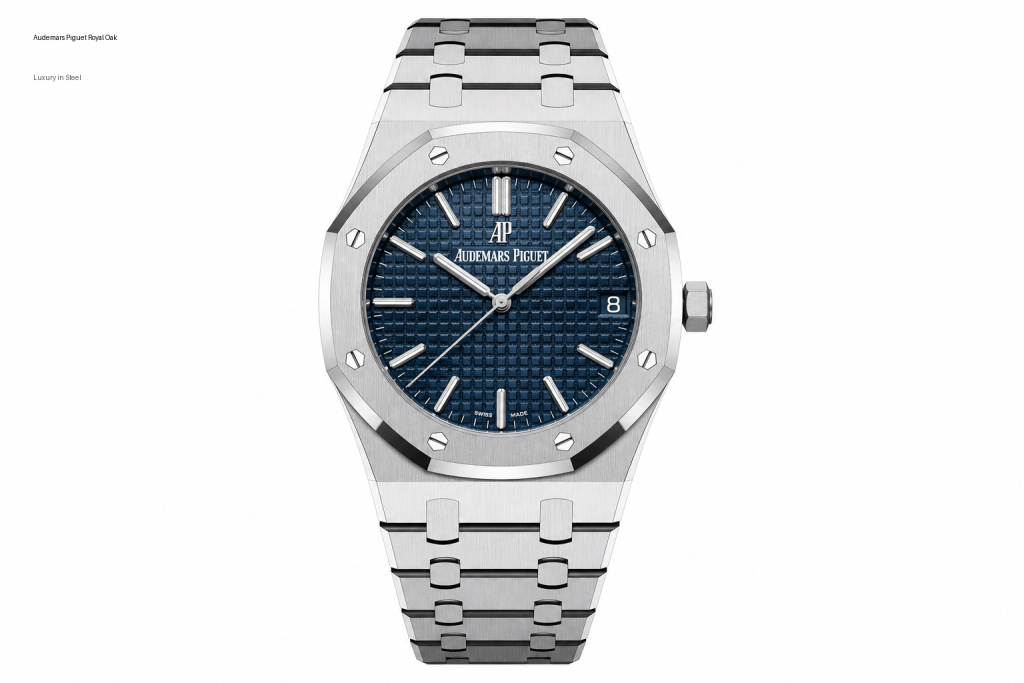
The resulting design was unlike any other watch produced at the time. The Audemars Piguet Royal Oak featured a large octagonal bezel secured by visible screws, a sharply angular case, and a seamlessly integrated steel bracelet.
Most shocking of all was the price. Despite being made of stainless steel, the Royal Oak was priced similarly to many gold dress watches.
Initially, the industry was uncertain how consumers would respond. Yet the daring vision of Audemars Piguet eventually proved revolutionary, establishing the blueprint for the modern luxury sports watch.
Gérald Genta’s Revolutionary Design
The genius of the Audemars Piguet Royal Oak lies primarily in its groundbreaking design language.
Gérald Genta drew inspiration from the shape of vintage diving helmets, particularly the exposed bolts securing the helmet structure. This concept evolved into the Royal Oak’s famous octagonal bezel with visible hexagonal screws.
The integrated bracelet became another defining feature of the watch. Instead of appearing as a separate attachment, the bracelet flows seamlessly into the case, creating a unified sculptural form.
This design approach gave the Audemars Piguet Royal Oak a level of visual harmony rarely seen in watchmaking.
The angular geometry of the case, combined with alternating brushed and polished surfaces, created extraordinary depth and sophistication. Every edge, bevel, and transition was carefully refined to elevate steel into a luxury material.
The Royal Oak demonstrated that true luxury could emerge not from precious metals alone, but from exceptional craftsmanship and innovative design.
This philosophy forever changed the direction of high-end horology.
The Famous Tapisserie Dial
One of the most recognizable details of the Audemars Piguet Royal Oak is its legendary “Tapisserie” dial.
The textured pattern consists of small square motifs that create remarkable visual depth and dynamic light reflection. Unlike flat dial surfaces, the Tapisserie finish gives the watch a constantly changing appearance depending on lighting conditions.
This subtle complexity became one of the defining aesthetic signatures of Audemars Piguet.
The dial design balances sportiness with refinement perfectly. Applied hour markers, slim hands, and carefully proportioned text maintain excellent readability while preserving the elegant character of the watch.
Over the decades, Audemars Piguet has introduced the Royal Oak in numerous dial colors and configurations, yet the Tapisserie pattern remains deeply associated with the collection.
For many collectors, it is impossible to imagine the Royal Oak without this iconic textured dial.
The Excellence of Audemars Piguet Craftsmanship
Although the Royal Oak is celebrated primarily for its design, the technical craftsmanship behind the watch is equally remarkable.
From the beginning, Audemars Piguet equipped the Royal Oak with ultra-thin, highly sophisticated movements finished to the standards of haute horlogerie.
Early models featured the legendary Calibre 2121, an exceptionally thin automatic movement admired for its precision, elegance, and engineering sophistication.
Modern Audemars Piguet Royal Oak models continue this tradition through advanced in-house calibers that combine reliability, accuracy, and refined finishing.
Collectors particularly admire the hand-finished details visible through exhibition case backs. Polished bevels, Geneva stripes, engraved rotors, and beautifully decorated bridges demonstrate the extraordinary craftsmanship of Audemars Piguet watchmakers.
This combination of avant-garde design and traditional Swiss horology is one of the reasons why the Royal Oak remains so respected within the collector community.
The Integrated Bracelet Masterpiece
The integrated bracelet of the Audemars Piguet Royal Oak is widely considered one of the greatest bracelet designs in watchmaking history.
Each link is carefully tapered and finished with a combination of brushed and polished surfaces that create extraordinary visual fluidity.
The bracelet contributes significantly to the comfort and elegance of the watch. Despite the angular design, the Royal Oak wears remarkably comfortably due to the articulation and precision of its bracelet construction.
Collectors often describe the bracelet of the Audemars Piguet Royal Oak as jewelry-level craftsmanship applied to a sports watch.
This extraordinary attention to detail elevated the concept of a steel bracelet far beyond utilitarian functionality.
Today, countless luxury sports watches imitate the integrated bracelet concept popularized by Audemars Piguet, yet few achieve the same balance of sophistication and engineering refinement.
Evolution of the Royal Oak Collection
Over more than five decades, the Audemars Piguet Royal Oak has evolved while preserving its unmistakable identity.
The collection now includes various sizes, materials, complications, and interpretations designed to appeal to different collectors.
One of the most important expansions occurred in 1993 with the introduction of the Royal Oak Offshore. Larger, more aggressive, and more technically focused, the Offshore introduced a bold new dimension to the Royal Oak family.
Meanwhile, classic references such as the Royal Oak “Jumbo” Extra-Thin continue to preserve the elegance and proportions of the original 1972 design.
Modern Audemars Piguet Royal Oak models are available in stainless steel, titanium, ceramic, white gold, rose gold, and platinum.
Despite these innovations, the essential character of the Royal Oak remains unchanged. The octagonal bezel, integrated bracelet, and Tapisserie dial continue to define the identity of the collection.
Cultural Impact and Collector Status
The influence of the Audemars Piguet Royal Oak extends far beyond watchmaking.
Over the decades, the watch has become a symbol of modern luxury, artistic taste, and exclusivity. Celebrities, athletes, entrepreneurs, and collectors around the world have embraced the Royal Oak for its unmistakable design and cultural prestige.
The steel versions of the Audemars Piguet Royal Oak have become especially sought after. Demand consistently exceeds supply, leading to waiting lists that can extend for years.
Certain references have appreciated dramatically in value, particularly limited editions and historically important models.
Collectors admire the Royal Oak not only for its financial value but also for its importance in horological history.
Owning an Audemars Piguet Royal Oak represents participation in one of the most significant design traditions in modern luxury.
Why the Audemars Piguet Royal Oak Changed Watchmaking
The true importance of the Audemars Piguet Royal Oak lies in the fact that it fundamentally redefined luxury watchmaking.
Before the Royal Oak, luxury watches were primarily dress-oriented and often crafted from precious metals. Sports watches existed largely as functional tools.
The Royal Oak merged these worlds together. It demonstrated that stainless steel, when combined with extraordinary finishing and visionary design, could become a luxury material.
This concept reshaped the industry permanently.
Without the success of the Audemars Piguet Royal Oak, many of today’s most iconic luxury sports watches might never have existed.
Its influence remains visible throughout contemporary horology.
Conclusion: The Ultimate Luxury Sports Watch
The Audemars Piguet Royal Oak stands as one of the most important and influential watches ever created.
Through Gérald Genta’s revolutionary design, exceptional Swiss craftsmanship, and bold reinterpretation of luxury, the Royal Oak transformed the watch industry forever.
Its octagonal bezel, integrated bracelet, and Tapisserie dial remain among the most recognizable design elements in all of horology.
More than fifty years after its introduction, the Audemars Piguet Royal Oak continues to define the concept of the luxury sports watch.
For collectors, enthusiasts, and lovers of timeless design, it remains not merely a watch, but a true icon of modern craftsmanship and innovation.
