
Post
Cartier Tank: A Century of Geometric Perfection
Th5
Cartier Tank: A Century of Geometric Perfection
Introduction: The Birth of an Icon
Few watches in the history of horology have achieved the timeless status, cultural influence, and artistic recognition of the Cartier Tank. More than a luxury timepiece, the Cartier Tank represents a design masterpiece that has transcended generations, trends, and changing tastes to become one of the most enduring symbols of elegance ever created.
Introduced in 1917 by Cartier founder Louis Cartier, the Cartier Tank transformed the world of watchmaking through its revolutionary geometric design. Inspired by the Renault military tanks used during World War I, the watch introduced a bold rectangular form that challenged the dominance of traditional round watches.
More than a century later, the Cartier Tank remains remarkably relevant. Its clean lines, harmonious proportions, and refined simplicity continue to appeal to collectors, designers, celebrities, and watch enthusiasts around the world.
The enduring success of the Cartier Tank lies in its ability to combine functionality with artistic perfection. It is a watch that feels both historical and modern, minimal yet luxurious, restrained yet deeply expressive.
For many collectors, the Cartier Tank is not merely a watch — it is one of the greatest achievements in design history.
The Origins of the Cartier Tank
The story of the Cartier Tank begins during one of the most transformative periods of the twentieth century. World War I had introduced new technologies and reshaped industrial design, including the emergence of Renault military tanks on the battlefield.
Louis Cartier became fascinated by the geometric form of these armored vehicles. Instead of seeing only machinery, he recognized the aesthetic power of their structure: strong vertical lines, balanced proportions, and functional simplicity.
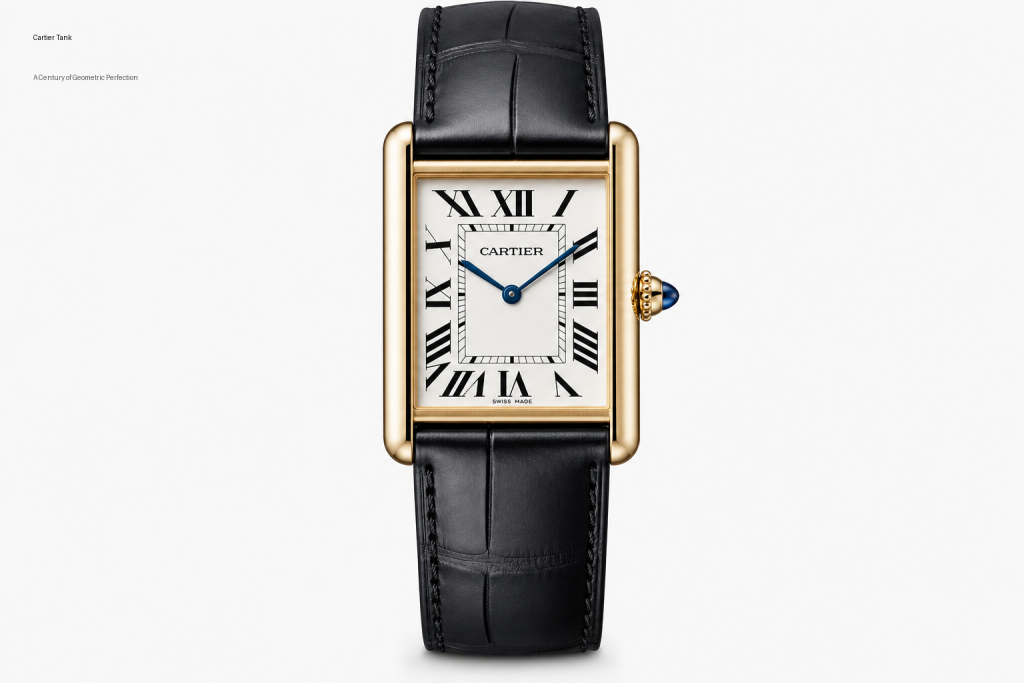
This inspiration led to the creation of the Cartier Tank in 1917. The watch featured a rectangular case flanked by two vertical brancards, visually echoing the tracks of military tanks viewed from above.
At a time when most watches remained round and heavily decorative, the Cartier Tank represented a radical departure from convention. Its minimalist geometry and architectural elegance established a completely new visual language in horology.
The first examples of the Cartier Tank quickly attracted attention among artists, aristocrats, and cultural figures who appreciated its modern sophistication.
Over the decades, the watch would become one of the most recognizable and influential luxury timepieces ever created.
A Revolutionary Design Philosophy
The brilliance of the Cartier Tank lies in its extraordinary simplicity.
Rather than relying on complicated decoration or excessive ornamentation, the watch achieves beauty through perfect proportion and geometric balance. Every element of the design serves a visual purpose.
The rectangular case immediately distinguishes the Cartier Tank from traditional watchmaking conventions. Its clean lines create a sense of architectural elegance that feels timeless rather than trend-driven.
The dial design further reinforces this minimalist sophistication. Roman numerals, chemin-de-fer minute tracks, and sword-shaped blued hands contribute to the instantly recognizable identity of the Cartier Tank.
Unlike highly technical sports watches or heavily complicated luxury pieces, the Cartier Tank communicates refinement through restraint.
This purity of design explains why the watch has remained virtually unchanged for more than a century. Great proportions do not require constant reinvention.
The Cartier Tank demonstrates that true elegance often emerges through simplicity rather than excess.
The Influence of Art and Architecture
The Cartier Tank is frequently admired not only as a watch but also as a work of design art.
Its geometric construction reflects the broader artistic movements of the early twentieth century, particularly Art Deco and modernist architecture. Straight lines, symmetry, and visual harmony became central elements of progressive design during this era.
The Cartier Tank perfectly captured this cultural shift. It represented a move away from ornate nineteenth-century aesthetics toward a cleaner and more modern visual language.
Many collectors and historians consider the Cartier Tank one of the earliest examples of modern industrial design applied successfully to watchmaking.
Its influence extends far beyond horology. Designers, architects, fashion icons, and artists have all admired the watch for its ability to balance utility with artistic sophistication.
Even today, the Cartier Tank feels remarkably contemporary because its design principles are rooted in timeless geometry rather than temporary trends.
Variations of the Cartier Tank
Although the essential identity of the Cartier Tank has remained consistent, Cartier has introduced numerous variations over the decades to suit different tastes and lifestyles.
The Cartier Tank Louis Cartier remains the purest expression of the original design. Featuring slim proportions, elegant brancards, and refined simplicity, it embodies the classic spirit of the collection.
The Cartier Tank Américaine introduced a slightly curved case profile, offering a more modern and ergonomic interpretation of the traditional rectangular form.
The Cartier Tank Française added a sportier bracelet integration and stronger case structure, appealing to contemporary luxury consumers seeking versatility and practicality.
Other variations, including the Tank Must and Tank Cintrée, have expanded the creative possibilities of the collection while preserving the unmistakable identity of the Cartier Tank.
This adaptability is one of the reasons why the design has endured so successfully across generations.
A Watch Worn by Cultural Icons
The cultural impact of the Cartier Tank extends far beyond the world of watch collecting.
Over the past century, the watch has been worn by royalty, political leaders, artists, actors, and style icons. Figures such as Andy Warhol, Princess Diana, Jackie Kennedy, and Yves Saint Laurent all famously appreciated the elegance of the Cartier.
Its universal appeal comes from its remarkable versatility. The watch feels equally appropriate in formal settings, artistic circles, business environments, and everyday wear.
Unlike oversized luxury sports watches that dominate attention, the Cartier communicates sophistication quietly and naturally.
Its understated elegance has helped establish the watch as one of the ultimate symbols of refined taste and timeless style.
Few watches possess such deep cultural significance across multiple generations and creative disciplines.
Mechanical Refinement and Craftsmanship
While the design of the Cartier often receives the greatest attention, the craftsmanship behind the watch is equally important.
Cartier combines Swiss watchmaking expertise with its heritage as one of the world’s premier luxury maisons. The movements inside modern Cartier models range from reliable quartz calibers to sophisticated mechanical in-house movements.
The cases are crafted with exceptional attention to detail, whether in stainless steel, yellow gold, rose gold, or platinum.
Polished surfaces, cabochon-set crowns, and refined dial finishing contribute to the luxurious identity of the Cartier.
Despite its minimalist appearance, the watch reflects tremendous care in execution and proportion. Every curve, edge, and visual detail feels intentional and perfectly balanced.
This harmony between design and craftsmanship is central to the enduring prestige of the Cartier.
The Cartier Tank as a Collectible
In recent years, the Cartier has become increasingly respected within the collector community.
Vintage models, limited editions, and historically significant references have appreciated considerably in value. Collectors are drawn not only to the watch’s aesthetic beauty but also to its historical and cultural importance.
The enduring popularity of the Cartier ensures strong long-term relevance within the luxury watch market. Unlike trend-driven pieces that rise and fall in popularity, the Tank remains permanently embedded within design history.
Its timeless appearance also makes it highly wearable compared to more specialized collectible watches.
For many enthusiasts, owning a Cartier means possessing a genuine piece of horological and artistic heritage.
Why Cartier Tank Remains Timeless
The greatest achievement of the Cartier is its ability to remain modern despite being more than one hundred years old.
Very few products in any category maintain relevance for such an extraordinary period without requiring dramatic redesigns. The Tank succeeds because its design is built upon universal principles of geometry, proportion, and simplicity.
It avoids excess decoration, aggressive trends, and unnecessary complexity. Instead, the Cartier focuses entirely on balance and refinement.
This timelessness explains why the watch continues to attract new generations of collectors while remaining deeply respected by long-time enthusiasts.
The Cartier is not simply fashionable — it is permanent.
Conclusion: A Century of Design Perfection
The Cartier stands as one of the most important and influential watch designs ever created.
From its origins inspired by Renault military tanks to its status as a global symbol of elegance and sophistication, the watch has transcended the boundaries of traditional horology.
Its geometric simplicity, architectural beauty, and cultural significance have allowed the Cartier to remain relevant for more than a century without losing its identity.
For collectors, designers, and enthusiasts alike, the Cartier represents the ultimate expression of timeless luxury — a watch where art, history, and functionality exist in perfect harmony.
In every detail, the Cartier proves that true design excellence never becomes outdated.
