
Post
Zenith El Primero: The First Automatic Chronograph
Th5
Zenith El Primero: The First Automatic Chronograph
Introduction: A Revolution in Watchmaking History
Few movements in the history of horology have achieved the legendary status of the Zenith El Primero. Revered by collectors, respected by watchmakers, and celebrated for its groundbreaking engineering, the Zenith El Primero stands as one of the most important technical achievements ever created in Swiss watchmaking.
Introduced in 1969 by Zenith, the Zenith El Primero became the world’s first fully integrated automatic chronograph movement. At a time when many manufacturers were racing to develop an automatic chronograph, Zenith succeeded in creating a movement that combined high-frequency precision, compact engineering, and exceptional reliability into a revolutionary mechanical system.
The achievement permanently transformed the reputation of Zenith within the luxury watch industry.
More than half a century later, the Zenith El Primero remains one of the most respected chronograph movements ever produced. Its high-beat construction, historical importance, and enduring technical excellence continue to influence modern chronograph engineering throughout the industry.
For collectors and enthusiasts, the Zenith El Primero represents far more than a mechanical movement — it symbolizes innovation, precision, and the relentless pursuit of horological perfection.
The Race to Create the First Automatic Chronograph
The 1960s represented an intense period of innovation in Swiss watchmaking.
Chronograph watches had already become highly popular among racing drivers, pilots, and professionals who required precise timing functions. However, most chronographs of the era relied on manual-wind movements, requiring users to wind the watch regularly by hand.
Manufacturers recognized that combining automatic winding technology with a chronograph mechanism would represent a major advancement.
Several companies competed aggressively to achieve this goal first, but the Zenith El Primero emerged as one of the most remarkable achievements of the period.
In 1969, Zenith officially introduced the Zenith El Primero, presenting the world’s first fully integrated automatic chronograph movement operating at an extraordinary frequency of 36,000 vibrations per hour.
This accomplishment immediately established Zenith as one of the most technically advanced watchmakers in the world.
Why Zenith El Primero Was Revolutionary
The significance of the Zenith El Primero extended far beyond simply adding automatic winding to a chronograph.
What truly distinguished the movement was its remarkable high-frequency operation.
While most chronograph movements of the period operated at lower frequencies, the Zenith El Primero functioned at 36,000 beats per hour. This higher frequency allowed the movement to measure elapsed time with exceptional precision, including accuracy to one-tenth of a second.
The smooth sweep of the chronograph seconds hand became one of the defining characteristics of the Zenith El Primero.
Achieving such performance required extraordinary engineering expertise. Higher beat rates place greater stress on movement components, demanding exceptional manufacturing quality and technical refinement.
Zenith successfully balanced precision, durability, and reliability in a way that few competitors could match.
This technical sophistication helped the Zenith El Primero become one of the most respected chronograph calibers ever created.
The Integrated Chronograph Architecture
Another major achievement of the Zenith El Primero was its fully integrated chronograph construction.
Some early automatic chronograph systems relied on modular designs that stacked chronograph mechanisms on top of existing automatic movements. While functional, these systems often increased thickness and complexity.
In contrast, the Zenith El Primero was engineered as a fully integrated movement from the beginning.
This integrated architecture improved efficiency, reliability, and mechanical harmony.
Collectors and watchmakers admire the elegance of the Zenith El Primero because every component works together within a cohesive mechanical structure.
The movement also featured a column-wheel chronograph system, widely regarded as superior for smooth operation and refined tactile feel.
Even decades after its introduction, the architecture of the Zenith El Primero remains highly respected within contemporary horology.
The Design of Zenith El Primero Watches
While the movement itself is legendary, watches powered by the Zenith El Primero also developed a distinctive visual identity.
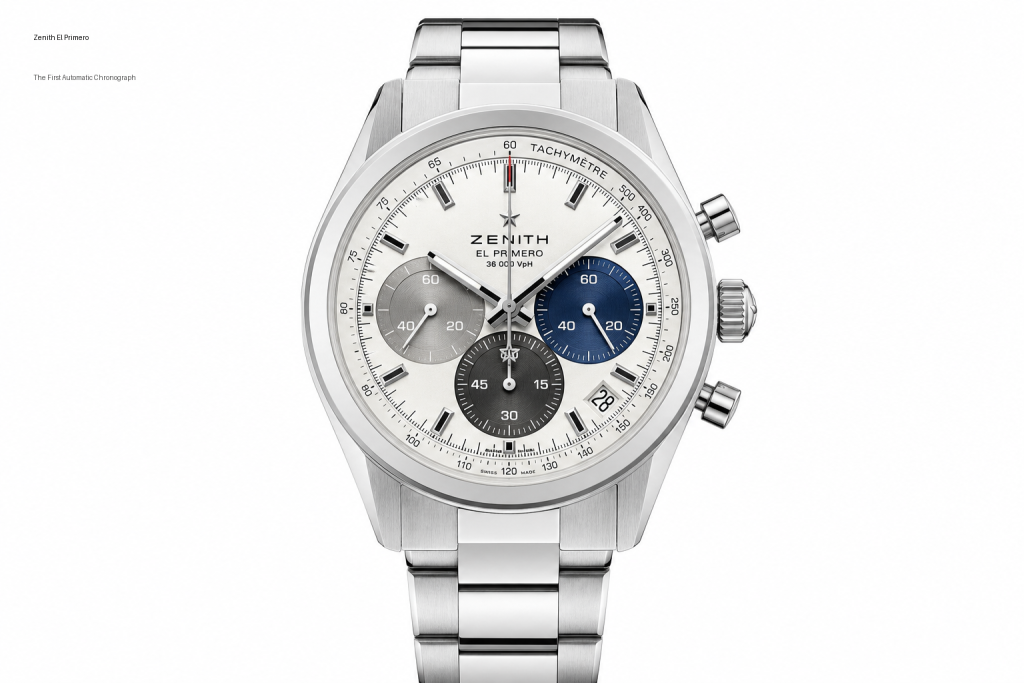
Classic models often feature a tri-color chronograph dial with overlapping blue, grey, and silver subdials that became strongly associated with the collection.
The three-register chronograph layout provides intuitive readability while maintaining visual balance.
Case designs vary across generations, yet many Zenith El Primero models maintain elegant proportions that blend sporty functionality with refined sophistication.
The watches are typically available in stainless steel, white gold, rose gold, and titanium, allowing collectors to choose configurations that suit their personal preferences.
Modern Zenith El Primero watches continue to preserve the spirit of the original 1969 models while incorporating contemporary manufacturing standards and updated materials.
This careful balance between heritage and innovation contributes significantly to the enduring appeal of the collection.
Exceptional Precision and Reliability
One reason the Zenith El Primero continues to be celebrated today is its extraordinary reliability and precision.
Despite operating at a high frequency, the movement proved remarkably durable over decades of real-world use.
The high-beat architecture allows the Zenith El Primero to maintain exceptional timing stability and chronograph accuracy.
Collectors often praise the movement for combining technical sophistication with practical everyday reliability — an achievement not always common among complex mechanical chronographs.
Modern versions of the Zenith El Primero benefit from contemporary improvements in lubrication, materials, and manufacturing techniques, further enhancing long-term performance.
Yet even with these updates, the essential engineering philosophy of the movement remains remarkably faithful to the original design introduced in 1969.
This continuity reinforces the legendary status of the Zenith El Primero within horological history.
Survival During the Quartz Crisis
The survival story of the Zenith El Primero is nearly as legendary as the movement itself.
During the 1970s quartz crisis, many Swiss manufacturers abandoned mechanical watchmaking in favor of quartz technology. Zenith itself faced pressure to discontinue production of the El Primero movement entirely.
However, a watchmaker named Charles Vermot secretly preserved the tools, plans, and machinery necessary to produce the Zenith El Primero.
His actions ultimately saved the movement from disappearing forever.
Years later, as appreciation for mechanical watchmaking returned, Zenith was able to revive production thanks to Vermot’s extraordinary foresight.
Without this preservation effort, one of the greatest chronograph movements in horological history might have been lost permanently.
This remarkable story contributes significantly to the mythology and collector appeal of the Zenith El Primero.
Influence on the Watch Industry
The impact of the Zenith El Primero extends far beyond Zenith itself.
Its technical achievements influenced the development of modern chronographs across the luxury watch industry.
Perhaps most famously, Rolex selected a modified version of the Zenith El Primero movement to power early generations of the Rolex Daytona during the late twentieth century.
This partnership further demonstrated the extraordinary quality and reliability of the movement.
Few chronograph calibers have achieved such widespread respect among competing manufacturers.
The El Primero proved that groundbreaking engineering could establish lasting horological significance and elevate an entire brand’s reputation permanently.
Its influence remains visible throughout modern mechanical chronograph design.
Collector Appeal and Investment Value
The El Primero has become increasingly sought after among collectors due to its historical importance and technical prestige.
Vintage references, particularly early models from the late 1960s and 1970s, command strong interest within the collector market.
Enthusiasts appreciate the El Primero not only for its performance but also for its role in one of the most important technological races in watchmaking history.
Modern Zenith chronographs powered by updated El Primero movements also remain highly respected because they preserve the legacy of the original caliber while offering contemporary reliability and finishing.
The enduring reputation of the El Primero continues to support stable collector demand and strong secondary market values.
For many enthusiasts, owning an El Primero-powered watch means owning a true piece of horological history.
Why Zenith El Primero Remains Important Today
More than fifty years after its introduction, the El Primero continues to represent one of the greatest achievements in mechanical watchmaking.
Its combination of high-frequency precision, integrated chronograph architecture, and enduring reliability remains deeply impressive even by modern standards.
The movement also symbolizes an era when Swiss watchmakers pushed the boundaries of mechanical engineering in pursuit of innovation and excellence.
The El Primero demonstrates that true horological greatness comes not only from luxury materials or exclusivity, but from meaningful technical advancement and enduring craftsmanship.
This authenticity explains why the movement continues to be admired by collectors, engineers, and enthusiasts worldwide.
Conclusion: A Legend of Mechanical Innovation
The El Primero stands as one of the most important and influential chronograph movements ever created.
By becoming the world’s first fully integrated automatic chronograph and introducing revolutionary high-frequency precision, Zenith secured its place permanently within horological history.
